
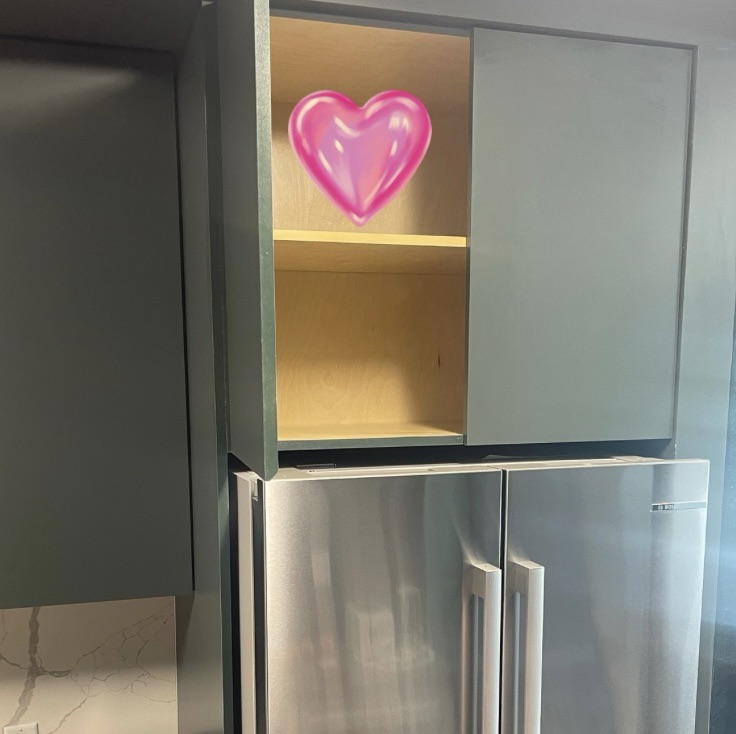
We are all born with innocence, looking for love, acceptance and support in life. At some point, life lessons come and we learn about trust, identity, vulnerability, and relationships.
Some of you have always had strong, firm, wiry characters. You say exactly what you mean and don’t let anyone get anything over on you. You often have big hearts and are purposeful where you spend your energy. I think it’s a great way to be.
Others are like me: super, soft hearts who will give everyone the benefit of the doubt. Sometimes, a person is wielding a dagger and beckoning you to come closer. You offer up a silent prayer that your care and understanding can help heal this person’s issue and you forge forward, ready to make a difference.
Betrayal turns a lot of soft hearts to stone. Here’s where the shelf comes in; our hearts are stowed away for safekeeping. Initially, a little stony layer is not necessarily a bad thing. It’s like a scab. A hardness forms because the fleshy part was bruised or injured. While it heals, the scab protects the vulnerable area from immediate re-injury or infection. We need time to be a little hard. It’s when we can assess what happened and decide how best to continue.
Unfortunately, sometimes we don’t shed the rigid exterior. If you have experienced that, ask yourself why that is and really dig for the answer. It’s different for everyone.
For me, I have come to understand that the force holding on to the barrier is a four-letter word: fear. I’m afraid that deep down, most people are no good. I’m afraid I will be hurt again and that next time I might not survive the devastation. My fear has caused me to lose trust in myself to be able to decipher who is safe.
Being mistreated made me feel more like a fool than I was angry at the perpetrator. I asked myself, “How did I let myself get here?” However, any lessons I might learn were temporarily drowned out by a rallying cry from my heart. “Shut it down!”
After some time, I realized I didn’t want to live hidden on a shelf – tucked away and inaccessible. It’s really not in my nature. However, I understood something had to change. I began to see that there was a difference between being available and being exposed. I continue to explore this dichotomy in prayer and in research.
Ezekiel 36:26 “I will give you a new heart and put a new spirit in you;
I will remove for you your heart of stone and give you a heart of flesh.”
The verse in Ezekiel 36:26 gives us a clue on how to manage our hearts. Not only do we get a new heart, but God also offers a new spirit to go with it. I couldn’t go back to being soft-hearted and still have the same spirit that put me in danger in the first place (and second and third). If I was going to relearn to trust myself, the most important step was letting God’s Spirit lead me.
My spirit can be people-pleasing. My spirit makes decisions out of insecurity and abandonment issues. My spirit hopes people stay even if I’m certain that chapters are ending. These are some of the things that make me vulnerable to pain and mishandling. I want my heart to be soft and viable, not mushy and weak.
God’s Spirit makes me kind and caring, but with eyes open so as not to be fooled. God’s Spirit gives me boldness to try something new but not feel afraid to disengage if the new things prove to be unhealthy. God’s Spirit helps me not to spend so much time figuring out people’s motives but instead, spend it giving love freely. After all, Jesus loved us when we didn’t even know Him and while we were actively rejecting Him (1 John 4:19, Romans 5:8). At the end of the day, the truth of a matter will always be revealed. I will be okay no matter what, in blessings and in lessons, because He promised me that (Romans 8:28).
In the past, I would endure in bad environments hoping I could change the person or situation and rarely won that battle in the end. What I’ve come to learn is the only way I can affect change is if I’m willing to let myself be changed. To be clear, our personal progress should never be displayed primarily to teach anyone a lesson but should always be motivated by our own desire to grow.
Still, people learn best by example than they do by a “to do” list. When I can take responsibility, admit my faults, and correct my heart’s course, someone else may be inspired to start doing the same. If they don’t, I’m already making progress in a better place and not as devastated by their lack of effort.
Softs hearts be encouraged. Our warmth, sensitivity, and empathy make us powerful in a world that can be dark and selfish. With self-awareness and purposefully re-training our thoughts, we can be true to ourselves without feeling like we are constantly in danger of being trampled on.
 Raíces: Rooted in Faith, Familia, and Friendship